Simulation & Modeling: Introduction
Some Definitions
- Modeling: Construct a conceptual framework that describes a system
- Simulation: Imitation of the real-world processes or systems
- System: groups of objects that are joined together in some regular interaction toward the accomplishment of some purpose
- System Environments: Outside the system. Changes here affect the system
- System Components
- Entity: Object of interest in the system
- Attribute: Propery of an entity
- Activity: A time period of a specified length
- State: Collection of variables necessary to describe the system.
- Event: Instantaneous occurrence that might change the state o f the system:
- Model: a representation o f a system for the purpose of studying the system.
- Discrete System: one in which the state variable(s) change only at a discrete set of points in time.
- Continous System: one in which the state variable(s) change continuously over time.
- Determinstic Model: Simulation models that contain no random variables are classified as deterministic.
- Stochastic Model: A stochastic simulation model has one variables a s inputs.
- Static Model: sometimes called a Monte Carlo simulation, represents a system at a particular point in time.
- Dynamic Model:represents systems as they change over time
Steps in a Simulation Study
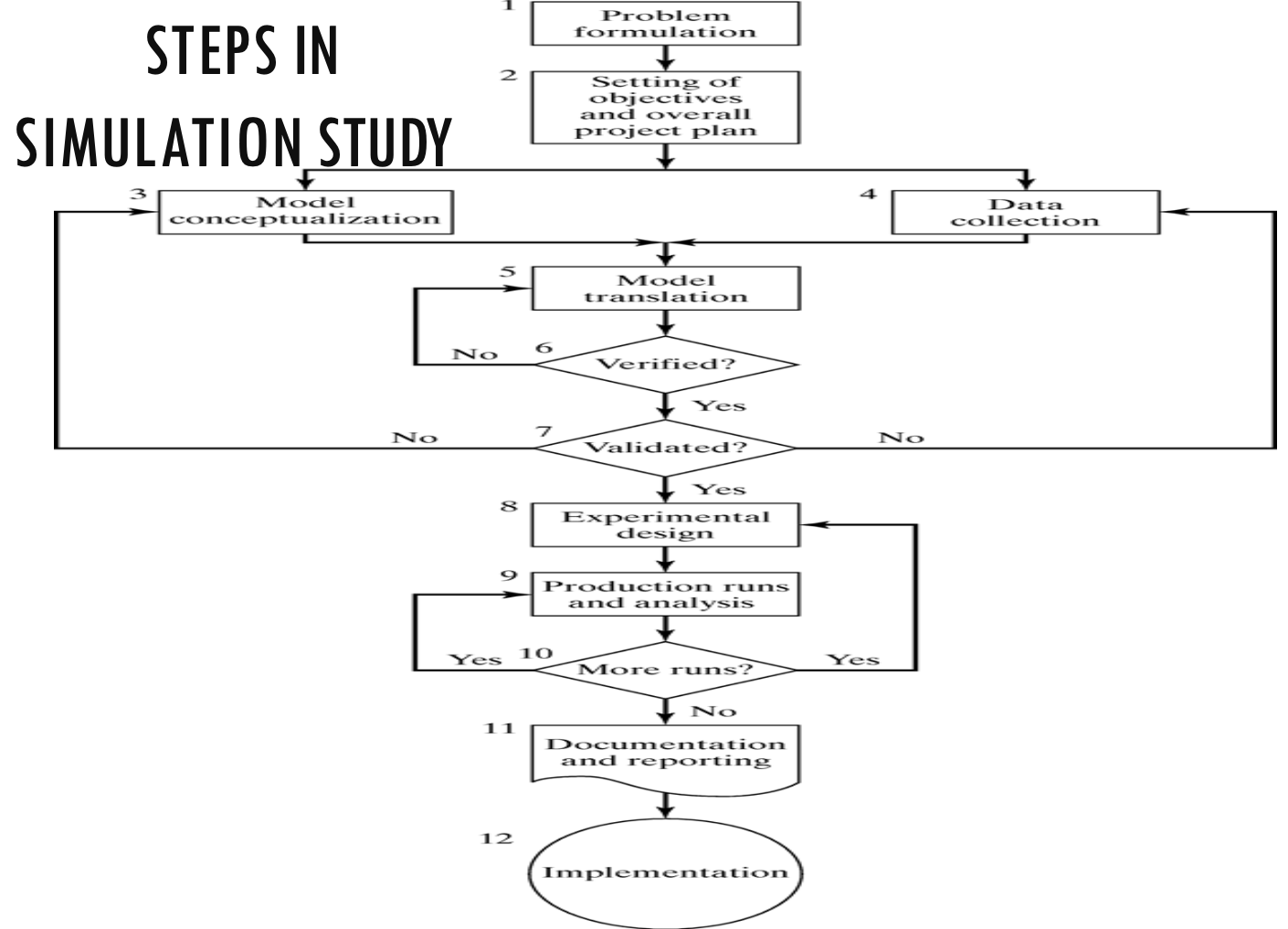
The steps of a simulation study are summarized in Figure fig-simulation-steps .
Problem Formulation: A statement of the problem that is clearly understood by both the simulation analyst and the client.
Setting of Objectives and Overall Plan: Project Proposal
Model Conceptualization and Building: You have to select the correct level of details and abstract the essential features.
Data Collection: Collect data for input analysis and validation
Model Translation: translate the system into a computer model
Verified?: the process of determining if the operational logic is correct.
Validated?: the process of determining if the model accurately represents the system.
Experimental Design: Deciding on elements related to the experiment (e.g. length of each run; number of runs)
Production Runs and Analysis: Statistical tests for significance
Documentation and Reporting